How to Display Kids' Art Without Losing Your Mind
The pile is not a storage problem. It is a decision problem — and it has a system.
There is a drawer in my kitchen that I have not opened without sighing in four years. It is full of paintings. Good ones, technically — a watercolor of a cat that looks like a loaf of bread, a self-portrait with eleven fingers, three separate drawings of the same dog.
Every August I would take them out, spread them on the dining table, feel like a monster for considering the recycling bin, and put them back in the drawer.
Here is what finally worked, and the short version is: I stopped treating it as a storage problem. It is a decision problem. Once you have a rule for deciding, the pile solves itself.
The test that took me three years to invent
Not everything deserves the wall. That sentence took me a long time to be allowed to think, so let me say the useful version of it:
Display is not the same as preservation. You can love a drawing and not frame it. Framing is a decision about what the wall should look like this season — not a verdict on your child's talent, and not a measure of how much you love them.
So: every piece that comes home goes through one question.
Would I put this up if a stranger had made it?
That is it. Not "is this good for a six-year-old," because everything a six-year-old makes is good for a six-year-old, and if you use that bar you will be framing eleven times a month. The stranger test asks the only question the wall actually cares about: is this interesting to look at.
Most things fail it. The keeper rate in our house is about one in fifteen. That is not a sad statistic — it means the wall is full of the fifteen that mattered.
What happens to the other fourteen
Photograph them. Flat surface, even daylight, phone straight above, no flash. Ten seconds each. I do this on the same day they come home, before they go anywhere, because the decision gets harder the longer a thing sits on the counter.
Then the originals go in one of two places, and there are only two:
- The keep-box. One box, physically small, chosen so it cannot grow. When it is full, something comes out. This is the entire archival system and it is honest about the fact that you are not, in fact, going to keep everything.
- The bin. Recycled with ceremony. Say something nice about it first. I am not being sarcastic — the ceremony is what makes this sustainable, because the alternative is that you never do it and the drawer wins.
The photos become the real archive. They take up no space, they survive everything, and in twenty years a folder of 2,000 photographed drawings will be worth more to your kid than a basement of yellowing paper.
Rotate, don't accumulate
The mistake I made for years: I thought the wall was for the best pieces, selected once, hung forever. It is not. It is for the current season, and rotating it is the whole trick for two reasons.
The wall stays alive. A rotating wall is a place your kid checks. A museum wall is furniture.
Rotation resets the decision. Taking something down is much easier than never putting it up. When the rule is "one goes up, one comes down," you are not rejecting last month's painting, you are just making room. The emotional weight disappears.
Our cadence is roughly monthly, and it takes fifteen minutes, because of the next thing.
The only frame property that matters
If you take one practical thing from this post, take this: use frames that open from the back, and keep a stack of pre-cut mats. Everything else about a frame is taste. This is logistics.
Most cheap frames open from the front — the glass and the backing come out toward you. If you have ever tried to reassemble one of those with a kid's painting that is 1/4 inch wider than the frame, you know why this matters. Get the ones where the back panel lifts off and the whole stack comes out as one unit.
Then: a mat turns anything into art. That is not a slogan, it is the actual mechanical reason a five-year-old's drawing of a loaf-shaped cat can hold a wall. The mat adds margin, margin creates focus, focus is what makes a thing look intentional instead of pinned.
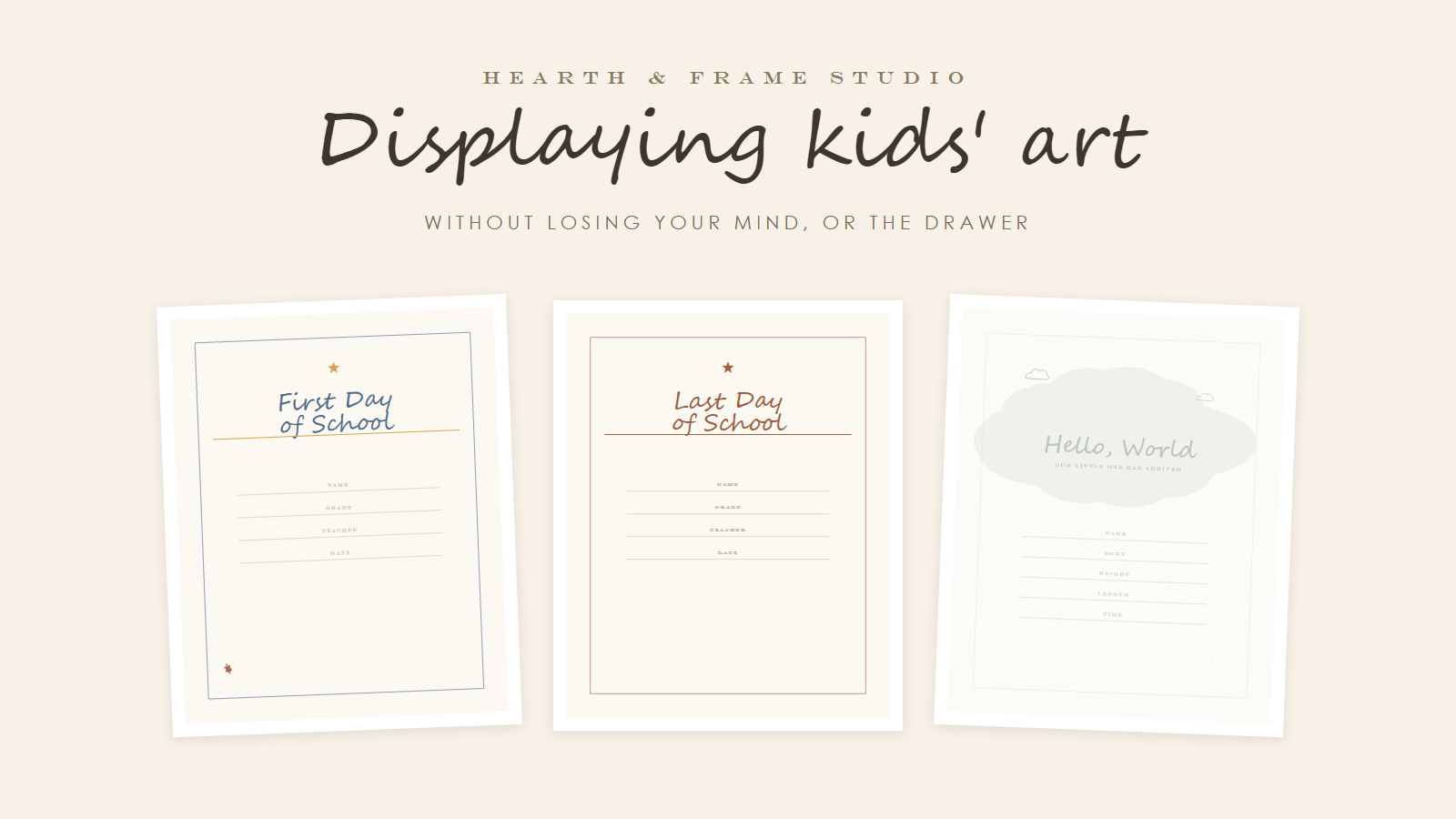
I print my mats rather than buying them — a mat for a standard frame costs about forty cents of cardstock instead of twenty to sixty dollars at a shop, which matters a lot when you are changing them twelve times a year. I use the Milestones & Memories set for exactly this: it has frames built for a changing display, including one designed for a first and last day of school, and it prints in the standard US sizes the cheap frames actually come in.
If you only want to test the idea, three designs are free — print one, cut the window, and see whether the cat earns its place.
Two things I learned the hard way: print at 100%, never "fit to page" (it shrinks the sheet four percent and the mat will not sit flat), and use matte cardstock, because glossy paper fights the cut edge and every scratch shows from across the room.
Hang low for their art, and it will look deliberate
Adult gallery rules say center art at 57 to 60 inches. That is standing eye level for a grown-up, and it is exactly wrong for a child's drawing.
Hang kids' art lower — center it at 40 to 48 inches, which is roughly the eye level of the person who made it. Two benefits. Your child can see it without being lifted, which is the entire point. And a low band of art reads as a deliberate gallery for small people, rather than art hung badly.
If you have both adult art and kid art in the same hallway, do not interleave them. Give the kids their own band, and give it its own line. Two clean horizontals beat one muddled one.
Three setups, depending on how much you want to manage
The single line
One long horizontal row, at kid height, along a hallway or above a low shelf. Frames all the same size, 2 to 3 inches apart. Rotate the contents, never the frames. This is the lowest-effort setup that still looks intentional, and it is what I would do if I were starting over.
The clip rail
A picture ledge or a wire with clips, so pieces can be swapped without a frame at all. Best for the 3-to-7 age range, when volume is highest and pieces are mostly flat. It looks casual by design, so a bad week for curation does not show.
The one nice frame
A single good frame in a spot of honor, opened from the back, contents changed monthly. This is for the house that wants art displayed but does not want art as a project. One frame, one rotation, no wall.
What I would avoid: the refrigerator door as the primary gallery. It works for a season, then it becomes a layer of paper that nobody looks at, including the kid. A door with three things on it, changed often, beats a door with thirty things on it, changed never.
Involve the kid and the whole problem shrinks
The single biggest change in our house was not a frame or a rule. It was handing over the choice.
Once a month, my ten-year-old picks what comes down and what goes up from the photographed archive. That is a real decision, and it is his. He has chosen things I would not have chosen, which is the point — and he has never once felt like his work was thrown away, because it was not: it was archived, catalogued, and considered.
If you take nothing else from this post, take the drawer. Pick one, open it, and run fifteen pieces through the stranger test. One goes on a wall, fourteen get photographed, and the drawer closes.
What is on your kid's wall right now? Send me a note — and if you are also staring at a wall of family photos that never made it out of the phone, this one is for you.